
AI Superintelligence: What, Who, and When? Everything You Need to Know
Comprehensive guide to AI superintelligence — definition, differences from AGI, who is racing to achieve it, potential benefits, safety challenges, and predictions for when it will be achieved.
AI superintelligence — a term coined by philosopher Nick Bostrom in 2014 — refers to artificial intelligence that far surpasses human cognitive abilities across virtually all domains. Not just capable of writing articles or generating illustrations, superintelligence is AI that can conduct scientific research, design new technologies, and solve complex problems that even the best human minds cannot currently address.
In 2026, the conversation about superintelligence is no longer science fiction. The world's largest research labs — from Google DeepMind ↗ to OpenAI ↗ — are racing to build AI with increasingly powerful reasoning capabilities. The question is no longer "will superintelligence be achieved?" but rather "when?" and "how do we prepare?". This article provides an in-depth discussion of what AI superintelligence is, who is racing to achieve it, its potential benefits, the safety challenges that must be addressed, and how everyday users can leverage current AI advancements.
What Is AI Superintelligence?
Superintelligence can be defined as "any intelligence that far surpasses the best human intelligence in virtually every relevant field" — including science, creativity, social skills, and strategic capability. This is not just AI that is faster or more accurate than humans, but AI that can think about things that humans cannot even imagine.
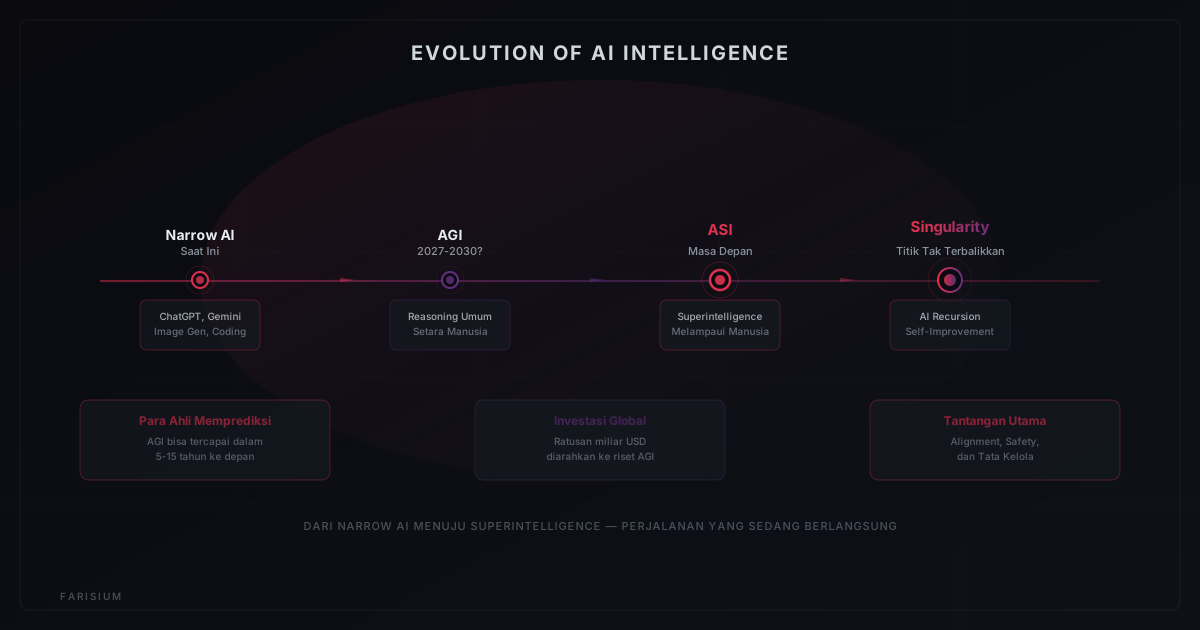
To put it in context, imagine the intelligence spectrum: we are currently in the era of Narrow AI — AI that excels at one specific task like drawing, writing, or playing chess. The next step is AGI (Artificial General Intelligence) — AI with human-level intelligence across multiple domains. Superintelligence sits at the far end of the spectrum: AI that transcends all human cognitive limits.
Narrow AI, AGI, and Superintelligence Differences
- Narrow AI: Single-domain specialist. Example: AI that generates anime images but cannot cook a recipe. This is what we have today.
- AGI: Human-level generalist. Can learn anything, adapt to new tasks, and perform cross-domain reasoning like humans.
- Superintelligence: Exceeds humans in all aspects. Can conduct research requiring 100 human years in a matter of days.
Who Is Racing to Achieve Superintelligence?
The race toward superintelligence involves some of the biggest players in the global technology industry, each with different approaches and philosophies.
OpenAI
OpenAI ↗ is one of the most vocal organizations about achieving AGI and superintelligence. With the continuously evolving GPT series models, OpenAI has demonstrated significant reasoning capability improvements year over year. OpenAI's official vision is ensuring that AGI benefits all of humanity.
Google DeepMind
Google DeepMind ↗ is the merger of two AI research giants — Google Brain and DeepMind. They have achieved monumental accomplishments like AlphaFold (solving the protein folding problem) and Gemini (a leading multimodal model). DeepMind takes a more research-science and safety-focused approach.
Anthropic
Anthropic ↗ was founded by former OpenAI leaders with a primary focus on AI safety. Their Claude model is designed with "Constitutional AI" principles — AI that learns to follow ethical guidelines internally. Anthropic believes that building safe AI is a prerequisite for achieving beneficial superintelligence.
Other Players
Meta, xAI (Elon Musk), Microsoft, and various startups like Mistral AI and Cohere also contribute to this race. On the government side, China and the European Union have national programs for advanced AI development. The combination of private investment and government support is creating an unprecedented pace of advancement.
Potential Benefits of AI Superintelligence
The potential benefits of superintelligence are immense and could fundamentally transform human civilization. Here are the areas where its impact will be most significant:
Scientific and Medical Revolution
Superintelligence could accelerate scientific discovery by thousands of times. Imagine AI capable of designing new drugs for currently incurable diseases, discovering new materials for renewable energy, or solving complex climate problems — all in a fraction of the time it would take the entire global research community.
Total Automation
Superintelligence could automate almost all types of work — from work automation to creative and strategic tasks. This means humans could be freed from repetitive work and focus on what truly gives meaning: social relationships, creativity, exploration, and personal development.
Solving Global Problems
Currently seemingly impossible problems — like global poverty, degenerative diseases, and climate change — could receive solutions that were previously unthinkable. Superintelligence has the capacity to see patterns and connections that humans cannot, opening up radical solution possibilities.
Personalized Education
Superintelligence could become the perfect personal tutor for every human on Earth — adjusting learning methods, speed, and content in real-time. The educational gap between rich and poor countries could be drastically narrowed.
Challenges and Safety Risks
The potential benefits of superintelligence cannot be separated from the accompanying risks. AI safety researchers have identified several critical challenges:
The Alignment Problem
How do we ensure that superintelligence has goals aligned with human values? This is the fundamental problem: a highly intelligent AI with goals that deviate even slightly from what we want could have consequences vastly different from what was intended. A study from Anthropic ↗ shows that alignment remains the biggest challenge in advanced AI development.
Control and Governance
Who controls superintelligence? How do we ensure that no single entity has too much power? These governance questions become increasingly urgent as AI capabilities grow. A strong international framework is needed to regulate the development and deployment of superintelligence.
Economic Impact
Superintelligence could cause workforce displacement on an unprecedented scale. If all jobs can be done by AI, how does our economic system adapt? Models like UBI (Universal Basic Income) and wealth redistribution are being seriously discussed by economists and policymakers.
Existential Risk
Some researchers like Nick Bostrom ↗ and Stuart Russell warn that uncontrolled superintelligence could pose an existential threat to humanity. While this scenario is still speculative, it is important to take preventive measures now rather than regret later.
Timeline: When Will Superintelligence Be Achieved?
Predictions about when superintelligence will be achieved vary widely among experts:
- Optimists (5-10 years): Researchers like Ray Kurzweil predict AGI by 2029 and superintelligence shortly after.
- Moderates (10-20 years): Many AI scientists believe superintelligence could be achieved in the next 10-20 years, though many technical challenges remain.
- Conservatives (20-50+ years): Some researchers argue that superintelligence still requires decades of fundamental research.
- Skeptics: Some experts doubt that superintelligence will be achieved anytime soon — or ever.
What is certain is that the current pace of AI advancement is far faster than most people predicted. Tools considered cutting-edge two years ago now feel commonplace. This speed of innovation makes predictions increasingly difficult, but one thing is clear: investment and interest in AI show no signs of slowing down.
Benefits of AI Superintelligence for Everyday Users
While superintelligence is still in the future, the benefits of continuously evolving AI can already be felt today. Here is how you can leverage current AI advancements:
- SEO Caption Generator: Use AI to create SEO-friendly product captions for social media and marketplaces — saving hours of work.
- Farisium Anime Generator: Generate high-quality anime illustrations from text descriptions alone — no drawing skills needed.
- AI Writing Assistant: Use ChatGPT, Claude, or Gemini to write emails, articles, and documents faster.
- AI Research: Use AI-powered research tools to analyze data and find relevant information instantly.
FAQ
Does AI superintelligence exist today?
Not yet. What we have today is Narrow AI — AI that excels at specific tasks. Superintelligence, AI that surpasses human abilities in all domains, is still a future concept, though significant progress is being made toward it.
Will superintelligence replace human jobs?
Superintelligence has the potential to automate most jobs currently performed by humans. However, many experts believe that jobs involving creativity, empathy, and social interaction will still require a human touch. The key is continuous adaptation and skill development.
Is superintelligence safe for humanity?
This is a question with no definitive answer yet. Many AI safety researchers are working hard to ensure that superintelligence, when achieved, can be controlled and aligned with human values. Organizations like Anthropic and Google DeepMind make safety a top priority in their research.
How can I prepare for the superintelligence era?
Focus on skills that are difficult for AI to replace: creativity, critical thinking, emotional intelligence, and adaptability. Learn to use AI as a tool — Take the Best Online AI Courses 2026 and practice directly with Farisium AI Tools to build AI literacy.
Who is most likely to achieve superintelligence first?
OpenAI, Google DeepMind, and Anthropic are the strongest candidates today. However, superintelligence will likely be achieved through collaboration or competition between multiple organizations, not by a single entity alone. Decisive factors include research investment, data availability, and approach to safety.
Conclusion
AI superintelligence represents one of the most transformative technological developments in human history. Its potential benefits — from scientific revolution to solving global problems — are immense. However, the safety and governance challenges are equally important. What is certain is that we are all in the midst of a journey toward a smarter future.
Rather than waiting for superintelligence to arrive, leverage what is available today. Use the SEO Caption Generator to create more effective marketing content, and explore All Farisium AI Tools to discover various AI tools that can boost your productivity. Also read about the Future of AI in Indonesia 2026 to understand AI trends and opportunities locally.
Explore Farisium AI Tools Now
Visit AI ToolsPertanyaan Umum
Not yet. What we have today is Narrow AI — AI that excels at specific tasks. Superintelligence, AI that surpasses human abilities in all domains, is still a future concept, though significant progress is being made toward it.
This is a question with no definitive answer yet. Many AI safety researchers are working hard to ensure that superintelligence, when achieved, can be controlled and aligned with human values. Organizations like Anthropic and Google DeepMind make safety a top priority in their research.
Focus on skills that are difficult for AI to replace: creativity, critical thinking, emotional intelligence, and adaptability. Learn to use AI as a tool — [[Take the Best Online AI Courses 2026](/blog/best-ai-courses-2026)] and practice directly with [[Farisium AI Tools](/ai)] to build AI literacy.
Related Articles
What Is Open Source AI? Definition, Platforms, and How to Choose
Learn what open source AI is, its differences from proprietary AI, popular platforms like TensorFlow and PyTorch, and how to choose the right open source AI solution.
What Model Does AI Mode on Google Use? Everything You Need to Know
Find out what AI model powers Google AI Mode, how Gemini 3 works behind AI search, its key features, and how to access it.
AI for E-commerce Business: Strategies and Tools 2026
Boost e-commerce sales with AI. Learn personalization strategies, chatbots, supply chain optimization, and AI tools for online businesses.

M. Faris Deni K.
Founder & Developer of Farisium. Writing about AI, technology, and platform development.