
6 Consumer Tech Trends 2026 You Can't Ignore: From AI Assistants to Smart Glasses
Learn the 6 most important consumer technology trends of 2026 — from AI assistants in smart homes, autonomous robots, smart glasses, to wellness tech and AI personalization.
Consumer technology trends are not just new gadgets adorning store displays. They are early indicators of how we will work, live, and interact in the future. From smartphones entering employee pockets to cloud storage changing how we store data — history proves that what consumers adopt at home today will become the standard at work tomorrow.
2026 is a pivotal year for consumer technology development. AI is increasingly integrated into everyday devices, home robots are starting to enter the mainstream market, and smart glasses are returning with far more sophisticated capabilities. This article will discuss the six most important consumer technology trends that will define 2026.
1. AI Assistants in Smart Homes
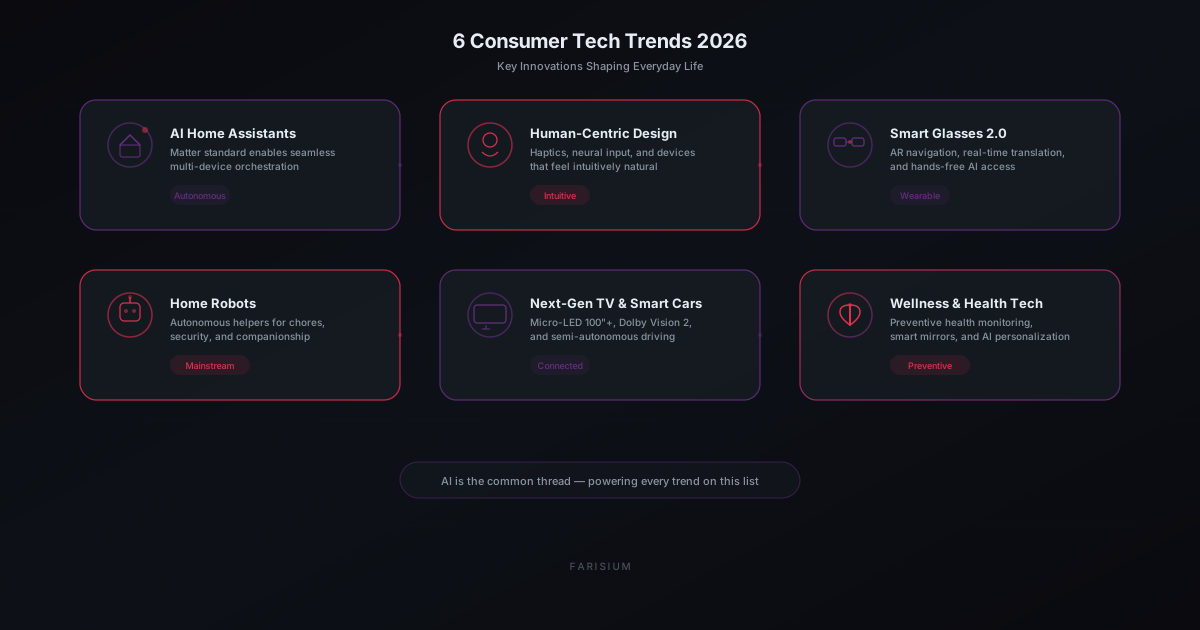
Smart homes have been around for years, but most previous systems were just internet-connected devices — not truly "smart." In 2026, that changes. Standards like Matter enable much smoother communication between various smart devices from different brands.
More excitingly, AI assistants now not only control smart home devices — they learn to anticipate needs and make decisions autonomously. Virtual assistants will coordinate lighting, climate, security, entertainment, and energy usage without explicit commands from household members.
This shift matters because it mirrors what is coming to offices and industrial environments. The same AI orchestration that manages home devices will soon coordinate enterprise IoT ecosystems: optimizing HVAC systems, preparing meeting rooms automatically, and managing energy efficiency at scale.
2. Devices That Feel More Human
One of the most significant shifts in consumer technology is the move away from cold, utilitarian devices toward technology that feels more human. We will be able to talk to, touch, and interact with screens and gadgets in ways that feel far more intuitive.
Conversational AI makes it easier to search for information and control apps. Beyond better voice-driven control, new neural input systems and advanced haptics — such as the EMG wristbands developed by Meta — enable much more intuitive gesture controls in both virtual and real-world environments.
Device design is also increasingly focused on aesthetics. Screens that resemble works of art, speakers inspired by sculpture, and sensory control systems that allow us to interact with technology in more natural ways — all represent a combination of psychology and aesthetics reminding us that humans are in control.
3. Autonomous Home Robots
What once felt like science fiction is becoming household reality. Consumer robots capable of performing chores, monitoring homes, assisting with caregiving, or providing companionship are nearing mainstream adoption.
Some of the latest robots being developed in Silicon Valley include Eggie, Neo, Isaac, and Memo. These robots are designed to help manage increasingly busy lives. However, questions remain: how much demand is there really for these bots? Will they just be playthings of the rich, or will they become affordable enough for mainstream use like robot vacuums already have?
The consumer market is training the future workforce in human-robot collaboration while normalizing autonomous systems that enterprises are rapidly deploying for warehouses, security, and hazardous environments.
4. Smart Glasses 2.0
Following some high-profile false starts, device manufacturers including Google and Meta are hoping 2026 will be the year smart glasses successfully crack the mainstream. What has changed since Google canceled its original Glass project 10 years ago?
Displays have gotten smaller and lighter, batteries have improved, and most importantly, AI has matured to the point where features like real-time language translation, augmented reality navigation, and hands-free access to AI assistants are a more viable proposition. Google and Meta now offer smart glasses with reasonable weight and genuinely useful AI features.
5. Next-Gen TVs and Smart Cars
Televisions are entering a new era. Micro RGB TVs made a splash at CES 2026, and Micro-LED displays from brands like Sony, Samsung, and LG will become far more affordable. Screens measuring over 100 inches will become increasingly common in living rooms.
Dolby Vision 2, expected to launch on next year's top-end models, promises sharper and brighter images than ever before. Combined with increasingly reasonable prices, we might never want to leave our comfortable home cinemas.
Outside the home, while fully self-driving cars are still a good way off, our cars will continue to get smarter. Better voice control, AI driver-assistance, and more intuitive in-car entertainment systems will become standard in 2026 vehicles.
6. Wellness Tech and AI Personalization
From smart mirrors that can measure heart rate and mental states to mattresses that analyze sleeping position and breathing patterns to optimize firmness and improve rest quality — wellness tech will continue to be big business in the coming years.
Interestingly, the wellness tech trend in 2026 will focus on the keywords "preventive" and "proactive." Major brands like Samsung, Apple, and Oura (the smart ring developer) are all working to find new ways to use body data and metrics to help us actively improve our physical and mental health.
Underneath all these trends is a fundamental shift in AI-driven personalization development. From OpenAI weighing a move into consumer health apps to wearable tech moving beyond mere recommendations — AI will learn your individual wants, needs, and desires.
FAQ
Which consumer technology trend will have the most impact in Indonesia in 2026?
Smart homes with Matter standard and AI personalization are the trends with the fastest impact in Indonesia. Smart device adoption is growing rapidly as prices become more affordable and internet connectivity improves. Meanwhile, smart glasses and home robots are still in the early adoption phase in the Indonesian market.
Are home robots already available in Indonesia?
Some robots like robot vacuums are already available and quite popular. However, new generation autonomous robots like Eggie and Neo are still in development and not yet widely available in Indonesia. Mainstream adoption for home robots still requires a few more years.
How do you prepare a home for smart home technology?
Start with basic devices like smart bulbs or smart plugs that support the Matter standard. Ensure your home Wi-Fi network is strong and stable. Choose a compatible ecosystem (Google Home, Apple HomeKit, or Amazon Alexa). Gradually add other smart devices as needed.
Are smart glasses safe for privacy?
Privacy remains a key concern. Make sure the smart glasses you choose have clear privacy policies, options to disable cameras and microphones, and strong data encryption. Choose brands that are transparent about how your data is collected and used.
What is the most affordable consumer technology to try in 2026?
Smart plugs and smart bulbs are the most affordable entry point for smart homes. For wellness tech, basic smart bands are available at affordable prices. AI assistants like Google Assistant and Siri are already available for free on smartphones you already own.
How does Farisium help users leverage AI trends?
Farisium provides AI tools that you can use right today — without waiting for trends to enter hardware. From Anime Generator to other AI tools, we ensure you can experience the benefits of AI directly and practically.
Explore AI Tools at Farisium
Visit Farisium AI ToolsPertanyaan Umum
Start with basic devices like smart bulbs or smart plugs that support the Matter standard. Ensure your home Wi-Fi network is strong and stable. Choose a compatible ecosystem (Google Home, Apple HomeKit, or Amazon Alexa). Gradually add other smart devices as needed.
Smart plugs and smart bulbs are the most affordable entry point for smart homes. For wellness tech, basic smart bands are available at affordable prices. AI assistants like Google Assistant and Siri are already available for free on smartphones you already own.
Farisium provides AI tools that you can use right today — without waiting for trends to enter hardware. From [[Anime Generator](/ai/anime-generator)] to other AI tools, we ensure you can experience the benefits of AI directly and practically.

M. Faris Deni K.
Founder & Developer of Farisium. Writing about AI, technology, and platform development.