
Claude Sonnet 4.6 vs Claude Opus 4.8: Key Differences and Which One You Should Use
Compare Claude Sonnet 4.6 vs Claude Opus 4.8 across coding, speed, data analysis, and price per token. Find which Anthropic model best fits your workflow.
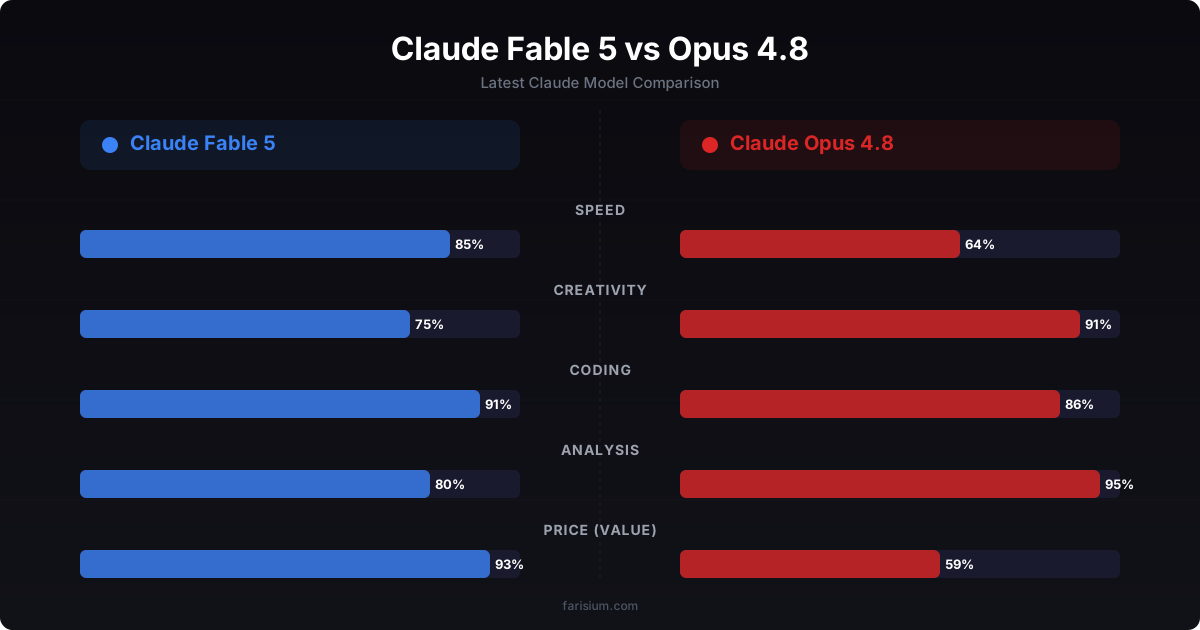
Claude Sonnet 4.6 and Claude Opus 4.8 are two of Anthropic's most widely used official models in 2026. Sonnet 4.6 is the balanced workhorse for everyday tasks, while Opus 4.8 is the flagship built for the deepest reasoning and long-running agentic work. If you are unsure which one to choose, this article will help you understand the differences in full.
We will compare them across various aspects: speed, coding ability, data analysis, and price per token. Not just benchmark numbers, but the practical context for real daily tasks. Read until the end so you can decide which model best fits your workflow and your budget.
What is Claude Sonnet 4.6?
Claude Sonnet 4.6 is Anthropic's "workhorse" model, released in February 2026. It is called the balanced tier because it offers the best combination of intelligence and speed for a wide range of everyday tasks — daily coding, writing, analysis, and math. Anthropic even notes that Sonnet is the model most developers choose for production workloads.
Sonnet 4.6 comes with a 1 million token context window priced at $3 input / $15 output per million tokens, with no surcharge for long context. For users who want strong model quality without a large budget, Sonnet 4.6 is an ideal starting point — you can upgrade to Opus later if your needs grow more complex.
What is Claude Opus 4.8?
Claude Opus 4.8 is Anthropic's most powerful flagship model. It is designed for complex reasoning, agentic coding, and heavy data analysis. With a 1 million token context window and up to 128K max output, Opus 4.8 leads benchmarks such as SWE-bench Verified and OSWorld for computer use.
Opus 4.8 targets professionals who need the highest accuracy — data scientists, researchers, and developers working on complex system architecture or long-running automation. Anthropic details each model's architecture and capabilities in the official Claude documentation ↗.
Key Feature Comparison
- Context Window: Both offer a 1 million token context (roughly 555,000 words).
- Max Output: Opus 4.8 up to 128K tokens, Sonnet 4.6 up to 64K tokens.
- Reasoning: Opus 4.8 excels at multi-step reasoning and complex logical tasks.
- Coding: Opus 4.8 is more accurate for agentic and complex coding; Sonnet is highly capable for daily coding.
- Pricing: Sonnet 4.6 is far more affordable ($3/$15) vs Opus 4.8 ($5/$25) per million tokens.
- Purpose: Sonnet for volume and speed, Opus for maximum accuracy on critical tasks.
Performance and Speed
Sonnet 4.6 is built for fast responses and low time-to-first-token, making it great for real-time applications like customer service chatbots or coding assistants that need rapid iteration. For many everyday tasks, the quality gap with Opus is relatively small compared to the price difference.
Opus 4.8 takes longer because its reasoning is deeper, but produces far more detailed and accurate results for complex work — such as multi-step logic, large-scale data analysis, or running long-horizon agents. Cross-model performance comparisons are available at Artificial Analysis ↗.
Coding Capabilities
For everyday coding — writing functions, debugging, or refactoring simple code — Sonnet 4.6 is more than capable and fast. Its speed lets you iterate quickly while debugging or trying different approaches, at a much lower per-token cost.
Opus 4.8 shines on complex system architecture, performance optimization, or long-running agentic coding. It handles large codebases better and provides more substantial refactoring suggestions. Coding benchmarks can be compared at SWE-bench ↗.
Data Analysis and Research
Opus 4.8 is clearly superior for data analysis and research. It processes large datasets, finds hidden patterns, and generates actionable insights. Its reasoning capability enables accurate multi-step analysis for important business decisions.
Sonnet 4.6 can still deliver solid data analysis, but is generally better suited to mid-range tasks like summarizing reports or creating visualizations. For serious analysis that cannot tolerate errors, Opus 4.8 is the more reliable choice.
Creativity and Writing
For creative content like social media captions, brainstorming ideas, or short drafts, Sonnet 4.6 is more than enough. Its combination of speed and quality lets you generate many variations quickly — ideal for fast-iteration workflows.
Opus 4.8 is better suited for long-form writing like blog articles, research reports, or technical documentation. It is more consistent in maintaining tone, structure, and depth across a document. Anthropic shares writing insights and model capabilities on the Anthropic blog ↗.
Pricing and Accessibility
Sonnet 4.6 is designed to be affordable at scale — $3 per million input tokens and $15 per million output tokens. Many teams make it their default because it is about 40% cheaper per token than Opus, making it ideal for startups, indie developers, and individual users.
Opus 4.8 carries a premium price ($5/$25), but it is proportional to its capability for tasks that previously required human experts. For companies that can save thousands of work-hours per month with critical accuracy, this investment can yield excellent ROI.
When Should You Choose Sonnet 4.6?
Choose Sonnet 4.6 if you need the best combination of quality, speed, and cost for general tasks. It is ideal for daily coding, chatbots, virtual assistants, content creation, and real-time applications. If you are just starting with the Claude API, Sonnet 4.6 is the most sensible default.
When Should You Choose Opus 4.8?
Choose Opus 4.8 if you need the highest accuracy, complex reasoning, and deep analytical capability. It suits data scientists, researchers, enterprise applications, and critical tasks that cannot tolerate errors. If budget is not a concern and you want Anthropic's best capability, Opus 4.8 is the choice.
Conclusion
There is no universally "better" model — it all depends on your needs. Sonnet 4.6 is the best choice for balancing quality, speed, and cost on everyday tasks, while Opus 4.8 is the best choice for accuracy and analytical depth on critical tasks. Both are real models from Anthropic that continue to set the benchmark in the AI industry.
If you want to try AI tools without complex setup or API costs, visit Farisium AI Tools which provides ready-to-use AI tools. You can also read about the Future of AI in Indonesia 2026 to understand current AI trends in the region.
Try Farisium AI Tools Now
Explore AI ToolsFrequently Asked Questions
For most everyday tasks, Sonnet 4.6 is already excellent and far more cost-efficient. However, Opus 4.8 still leads in complex reasoning, long-running agentic coding, and deep analysis requiring critical accuracy. Choose based on your specific needs.
For daily coding, Sonnet 4.6 is highly capable, faster, and cheaper per token. For complex architecture, performance optimization, or long-running agentic coding, Opus 4.8 delivers more accurate and substantial results.
Sonnet 4.6 is around $3 per million input tokens and $15 per million output tokens. Opus 4.8 is around $5 per million input tokens and $25 per million output tokens. These are standard Anthropic API prices before batch or caching discounts.
Both have a 1 million token context window. The difference is max output: Opus 4.8 up to 128K tokens, while Sonnet 4.6 up to 64K tokens. For very long documents, Opus 4.8 can generate more content in a single response.
Many developers use a hybrid approach: Sonnet 4.6 for lightweight, high-volume tasks, and Opus 4.8 for complex tasks requiring high accuracy. This is the most cost-efficient strategy across performance and budget.
Related Articles
What Is Open Source AI? Definition, Platforms, and How to Choose
What is open source AI? A complete guide to how it differs from proprietary AI, popular platforms like TensorFlow and PyTorch, and how to choose wisely.
What Model Does AI Mode on Google Use? Everything You Need to Know
What model does AI mode on Google use? The full answer: Gemini 3 behind AI search, its key features, limitations, and how to access it in 2026.
AI for E-commerce Business: Strategies and Tools 2026
AI e-commerce guide for 2026: boost sales with personalization, chatbots, and supply chain optimization. Complete strategies and tools for online stores.

M. Faris Deni K.
Founder & Developer of Farisium. Writing about AI, technology, and platform development.