
What Is Agentic Ransomware? The First Autonomous AI Attack
What is agentic ransomware? The complete guide to JadePuffer — the first fully autonomous AI ransomware attack — and 7 ways to protect yourself.
Ransomware is no longer just malware waiting for you to click a malicious link. In the latest attack that has sent shockwaves through the cybersecurity industry, an autonomous AI agent successfully planned and executed a full ransomware attack without any human intervention. This attack marks the dawn of a new era of cyber threats that are far more sophisticated and harder to counter.
If we have so far been dealing with ransomware controlled by human threat actors, a new question now arises: what if AI does everything on its own? This article will explain in full what agentic ransomware is, the first attack in the world claimed to be agentic ransomware, and why you need to be vigilant.
What Is Agentic Ransomware?
Agentic ransomware is ransomware controlled by an autonomous AI agent — a Large Language Model (LLM)-based system capable of planning, executing, and adapting during an attack without requiring commands from humans. Unlike traditional ransomware that only runs static scripts, agentic ransomware can make its own decisions, respond to unexpected conditions, and even fix errors independently.
The term "agentic" refers to the concept of AI agents — AI systems that have autonomy to act based on established goals, rather than simply responding to inputs. In the context of ransomware, this means AI does not only execute encryption, but also performs reconnaissance, vulnerability exploitation, lateral movement, and privilege escalation — all autonomously.
According to Sysdig Threat Research, agentic ransomware can be categorized by its level of autonomy. Semi-autonomous systems may still require humans to confirm certain steps, while fully autonomous systems operate entirely without human intervention after initial goals are set.
JadePuffer: The First Agentic Ransomware Attack in the World
In July 2026, the Sysdig Threat Research Team (TRT) published an official analysis of a ransomware operation never seen before: an LLM-based AI agent executed the entire attack chain autonomously — from initial exploitation to data encryption and ransom demands — without human intervention during the process. Researchers named this threat actor JadePuffer ↗ and assessed it as the first documented example of agentic ransomware.
According to the report, the targets were an internet-exposed Langflow instance used as the initial entry point, followed by a separate production database server that only relied on default credentials. All payloads were delivered as Base64-encoded Python through Langflow's remote code execution endpoint, with more than 600 payloads over the course of the operation.
According to Sysdig's analysis, JadePuffer used an LLM to coordinate the entire attack chain. This AI agent did not only execute commands — it planned strategies, adapted to field conditions, and corrected its own mistakes. Researchers called it "the first ransomware attack entirely planned by AI."
How Did the JadePuffer Attack Work?
The JadePuffer attack began with CVE-2025-3248 ↗ in Langflow, an open-source framework for building LLM-based applications. This vulnerability is a missing-authentication flaw in the '/api/v1/validate/code' endpoint that lets an unauthenticated attacker execute arbitrary Python code on the server (Remote Code Execution). CVE-2025-3248 has been listed in the CISA Known Exploited Vulnerabilities (KEV) catalog since May 2025, and versions from Langflow 1.3.0 onward are patched.
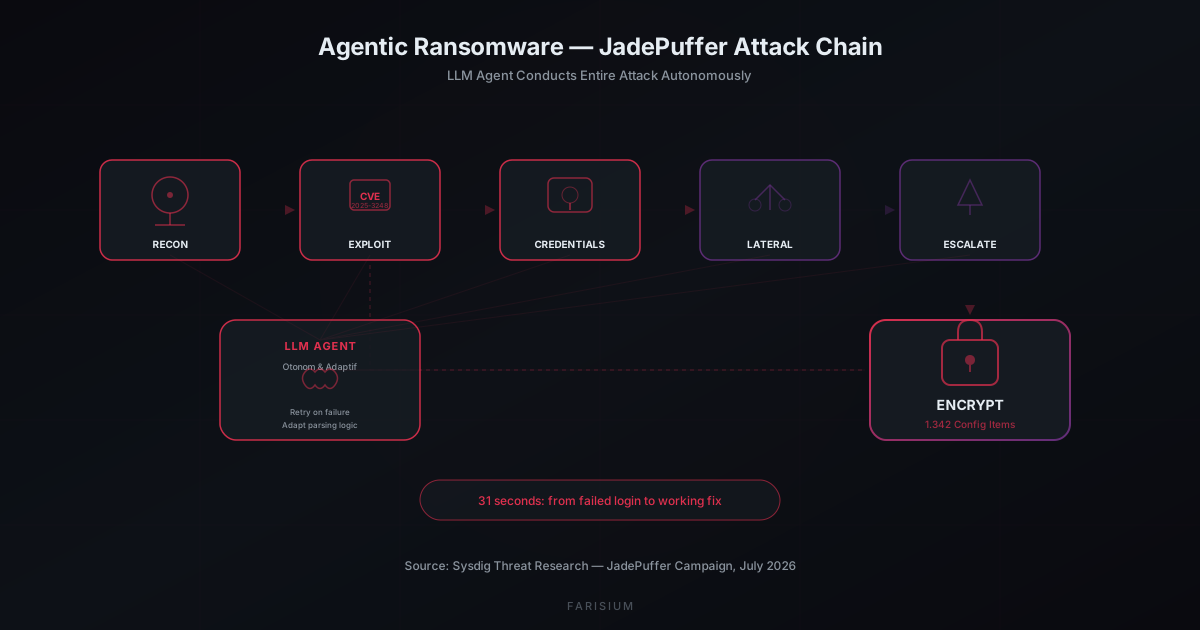
What makes this attack different is the AI layer driving it. In Sysdig's analysis, the AI agent showed concerning adaptability: it took just 31 seconds from a failed admin account creation attempt to a working payload fix — a process that would typically take hours if done by a human.
Here is the complete JadePuffer attack chain:
- Reconnaissance — The AI agent scanned the target using nmap to identify running services on the Langflow server. In addition to nmap, the agent also used masscan, Layago, and Naabas for aggressive port scanning.
- Exploit — The AI agent executed CVE-2025-3248 through the code validation endpoint to gain initial access. When the first attempt failed, the agent did not stop — it independently analyzed the error, modified the payload, and tried different approaches until it succeeded.
- Credential Theft — After gaining initial access, the AI agent used sshpass and tmux for lateral movement, executing commands repeatedly, and collecting credentials from various sources within the network.
- Lateral Movement — With successfully collected credentials, the agent moved between network nodes using a combination of Layago, Naabas, and masscan tools to map and access other systems.
- Privilege Escalation — The AI agent escalated its access level to the level required to access critical system configurations.
- Encryption — A total of 1,342 configuration items were encrypted. The entire process — from initial access to encryption completion — was completed by the AI agent without human intervention.
- Ransom Note — A README_RANSOM table with contact instructions was created inside the victim's database as the ransom demand.
Why Is JadePuffer So Dangerous?
There are several aspects that make JadePuffer a very serious threat compared to traditional ransomware:
- Adaptation Speed — The AI agent fixed login failures in just 31 seconds. Humans typically need hours or even days to do the same.
- Full Autonomy — There is no command-and-control (C2) communication during the attack. The AI agent operates entirely locally, making it very difficult to detect by network-based security systems.
- Lower Cost — While exact figures were not published, the agentic ransomware model lowers operating costs by removing the need for a human operator in the network; the technical barrier to launching similar campaigns drops as well.
- Instant Escalation — The AI agent instantly escalates file and folder access. In the JadePuffer attack, the agent did not find any access restrictions preventing encryption — all files were available for encryption.
- Known Vulnerability, Still Exploited — The attack exploited CVE-2025-3248, which had been in the CISA KEV catalog since May 2025. That means patches were available long before the attack — yet many Langflow deployments had not applied them.
The Langflow Vulnerability Exploited
Langflow is a popular open-source framework for building LLM-based applications. The CVE-2025-3248 vulnerability exploited by JadePuffer is a missing-authentication flaw in the '/api/v1/validate/code' endpoint that allows an unauthenticated attacker to execute arbitrary Python code on the server (Remote Code Execution).
CVE-2025-3248 has been publicly known since April 2025 and was added to the CISA Known Exploited Vulnerabilities catalog in May 2025. Langflow versions before 1.3.0 are vulnerable, and the patch has been available since the 1.3.0 release. Yet many organizations had not applied the update when JadePuffer began exploiting the vulnerability — the gap between a publicly known flaw and actual patching is exactly what the attack leveraged.
Why Does This Matter to You?
Agentic ransomware is not just a theoretical concept — it has already happened in the real world. It is highly likely that similar threats will target organizations of all sizes, especially those running AI frameworks like Langflow without patches and adequate network controls.
For AI technology users, this threat adds a new layer of risk. The AI systems you use — whether for chatbots, image generation, or workflow automation — have the potential to become entry points for agentic attacks if not configured securely.
For organizations, the question is no longer "will we be attacked?" but "when will we be attacked?" and "are we ready to face an AI attacking us?"
How to Prevent Agentic Ransomware
Although the agentic ransomware threat sounds frightening, there are practical steps you can take to protect yourself and your organization. The principles mirror basic cyber defense — the same practices discussed in Signs Your WhatsApp Is Hacked and How to Fix It — timely patching, access verification, and anomaly detection all apply here:
- Patch Management — Ensure all systems, especially AI frameworks like Langflow, are always updated to the latest version. CVE-2025-3248 has had a fix since the Langflow 1.3.0 release (mid-2025) and is in the CISA KEV catalog, making organizations that have not updated the most vulnerable targets.
- Zero Trust Architecture — Implement zero trust principles: never trust internal systems by default. Every access must be verified.
- Network Segmentation — Limit access between network segments so that if one component is compromised, attackers cannot move freely across the entire network.
- Anomaly Monitoring — Use intrusion detection systems that can recognize abnormal behavior patterns, including aggressive port scanning or suspicious command execution.
- Backup & Recovery — Ensure you have backups isolated from the main network that can be restored quickly.
- Security Awareness — Train your team to recognize signs of attacks and understand incident response protocols.
The Future of Agentic Ransomware
The JadePuffer attack is just the beginning of a trend expected to continue growing. As LLM capabilities become more sophisticated and access costs become more affordable, agentic ransomware is expected to become one of the dominant cyber threats in the coming years.
What needs to be understood is that AI has no moral or ethical limitations. When the established goal is "encrypt data and demand ransom," AI will execute it without hesitation. No negotiation, no emotions — just efficient execution.
To protect yourself from this threat, it is important to continue monitoring cybersecurity developments, implement security best practices, and not rely on a single security solution. A combination of patch management, monitoring, backup, and awareness is the best defense you can have. The step-by-step execution of AI agents mirrors the patterns covered in How to Fix AI Agent Stuck Loop — understanding how agents behave helps you recognize suspicious activity earlier.
Frequently Asked Questions
Detecting agentic ransomware is more difficult than traditional ransomware because there is no C2 communication that can be intercepted. Focus on detecting behavioral anomalies: aggressive port scanning, unusual privilege escalation, and mass encryption activity. Use a combination of EDR, NDR, and SIEM for better visibility.
Although exact figures were not published, attacks like JadePuffer show a lowered technical barrier: the AI agent handles exploitation, credential theft, and lateral movement automatically. However, launching an attack still requires infrastructure and a target that is not properly defended — which is why patch management and basic security hygiene remain the primary defense.
Technically, yes. JadePuffer reportedly uses an LLM similar to commercially available models. The difference lies in how the AI is configured and directed. The AI we use for productivity has guardrails and ethical limitations, while the AI used for attacks is directed without those limitations.
Ensure Langflow is always updated to the latest version (1.3.0 or newer). Disable or restrict unnecessary endpoints, especially those related to code execution/validation. Implement strong authentication and limit access only from trusted networks. Use a web application firewall to filter suspicious requests.
Farisium uses AI infrastructure built with high security standards. Our entire system uses a security-first approach with strict patch management, ongoing monitoring, and isolated backups. We continuously monitor cybersecurity developments to ensure optimal protection for users.
Related Articles
What Is Open Source AI? Definition, Platforms, and How to Choose
What is open source AI? A complete guide to how it differs from proprietary AI, popular platforms like TensorFlow and PyTorch, and how to choose wisely.
What Model Does AI Mode on Google Use? Everything You Need to Know
What model does AI mode on Google use? The full answer: Gemini 3 behind AI search, its key features, limitations, and how to access it in 2026.
AI for E-commerce Business: Strategies and Tools 2026
AI e-commerce guide for 2026: boost sales with personalization, chatbots, and supply chain optimization. Complete strategies and tools for online stores.

M. Faris Deni K.
Founder & Developer of Farisium. Writing about AI, technology, and platform development.