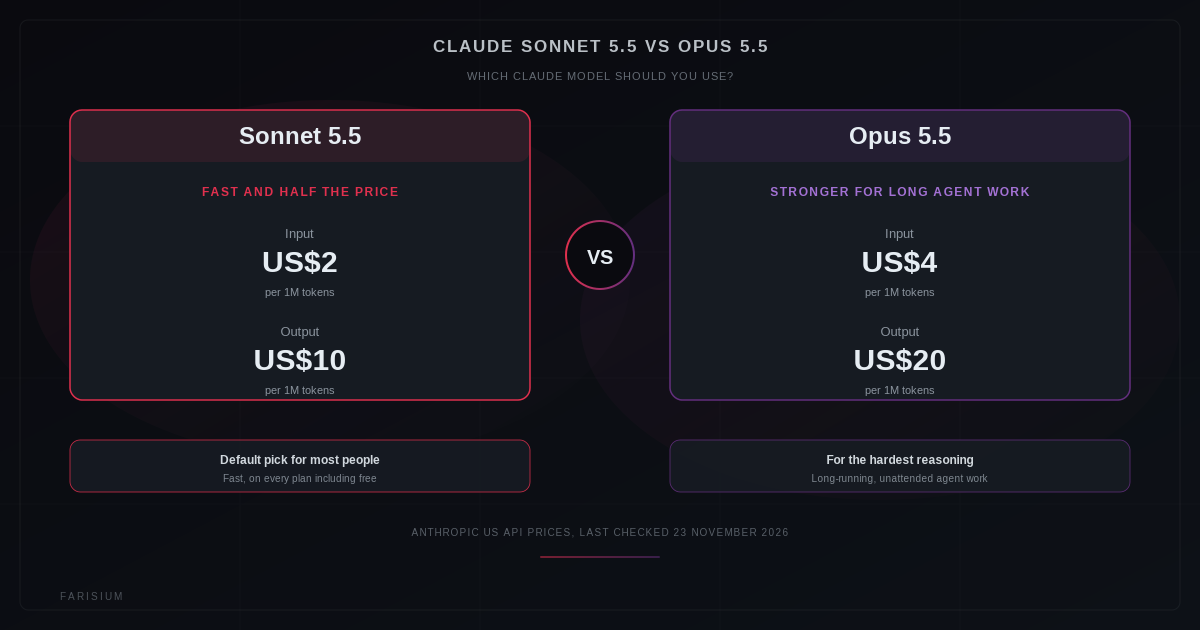
The short answer: for most people, use Claude Sonnet 5.5. It is fast, available on every plan including free, and costs half as much as Opus 5.5 through the API (US$2 in / US$10 out per million tokens, against US$4 / US$20). Move to Claude Opus 5.5 only for long-running, unattended agent work and the hardest reasoning — that is where Anthropic itself places it.
This article was fully rewritten in November 2026 because the old comparison (Sonnet 4.6 vs Opus 4.8) is out of date: Sonnet 5 shipped on 30 June 2026, Opus 5.5 on 22 September 2026, and Sonnet 5.5 on 28 September 2026. The old slug naming Fable 5 was also wrong — the old article never covered Fable — so the slug was updated and the old slug redirects here. All prices are Anthropic US API prices, last checked 23 November 2026.
The Current Claude Family
- Claude Sonnet 5.5 (28 September 2026): the best combination of speed and intelligence, in Anthropic words. API US$2/US$10 per million tokens. On every plan, including free.
- Claude Opus 5.5 (22 September 2026): the model Anthropic recommends for most developer work. API US$4/US$20 per million tokens. From the Pro plan (US$20/month).
- Claude Haiku 5.5 (7 October 2026): for high-volume, short, repetitive jobs. API from US$0.10/US$0.50 per million tokens for prompts up to 100,000 tokens.
- Claude Fable 5.2 (9 November 2026): Anthropic most capable model for the hardest reasoning and long agent tasks. Its price was cut to US$8/US$40 per million tokens, from US$10/US$50. Not on the free plan.
All four models use a 1-million-token context window. Benchmark figures below are vendor-reported numbers from the launch announcements, not our own independent testing.
Sonnet 5.5 vs Opus 5.5: Head to Head
- Speed: Anthropic rates Sonnet 5.5 Fast and Opus 5.5 Moderate. For interactive chat and quick edits, Sonnet feels more responsive.
- API price: Sonnet US$2 in / US$10 out per million tokens; Opus US$4 / US$20 — exactly twice as much.
- Plan access: Sonnet is on the Free plan; Opus starts at Pro (US$20/month or US$200/year in the US).
- Strength: Opus 5.5 is clearly stronger for complex, open-ended work that needs sustained judgment, including long-running coding agents. Sonnet 5.5 is strongest on well-scoped everyday tasks, bug fixes, and polished documents, spreadsheets, and slides.
- Context: both offer 1 million tokens, with a 128K-token maximum output.
Which One to Pick
Pick Sonnet 5.5 as the default: everyday writing and editing, well-scoped coding, data analysis, and any work you supervise directly. It costs half as much as Opus and runs faster, so for most tasks the result is no worse.
Pick Opus 5.5 when the task runs for a long time without your supervision — for example a coding agent working on one project for hours — or when the reasoning is open-ended and hard, where a mistake midway is expensive. For short, repetitive jobs at scale, Haiku 5.5 is far cheaper than either.
Fable 5.2 only matters if you already use Opus 5.5 and keep hitting its limits on the hardest reasoning; for most users, the price gap is not worth it.
How to Save on API Costs
- The Anthropic Batch API gives a 50% discount for work that can wait.
- Cached prompt reads on Opus 5.5 and Sonnet 5.5 cost 5% of the input price.
- Use Haiku 5.5 for classification, extraction, and short bulk tasks — it costs a tenth of Sonnet for short prompts.
- Check the Anthropic pricing page before budgeting: model prices change when new releases land.
Conclusion
The practical rule: Sonnet 5.5 as the default, Opus 5.5 for long agent runs and the hardest reasoning, Haiku 5.5 for high-volume short work, and Fable 5.2 only when Opus runs out of headroom. This comparison holds as of November 2026 — the Claude family changes every few months, so check the Anthropic models page before deciding.