
AI for Content Marketing: Strategies and Tools 2026
AI content marketing in 2026: research, production, and distribution strategies with AI — including a weekly workflow for small teams and the best tools.
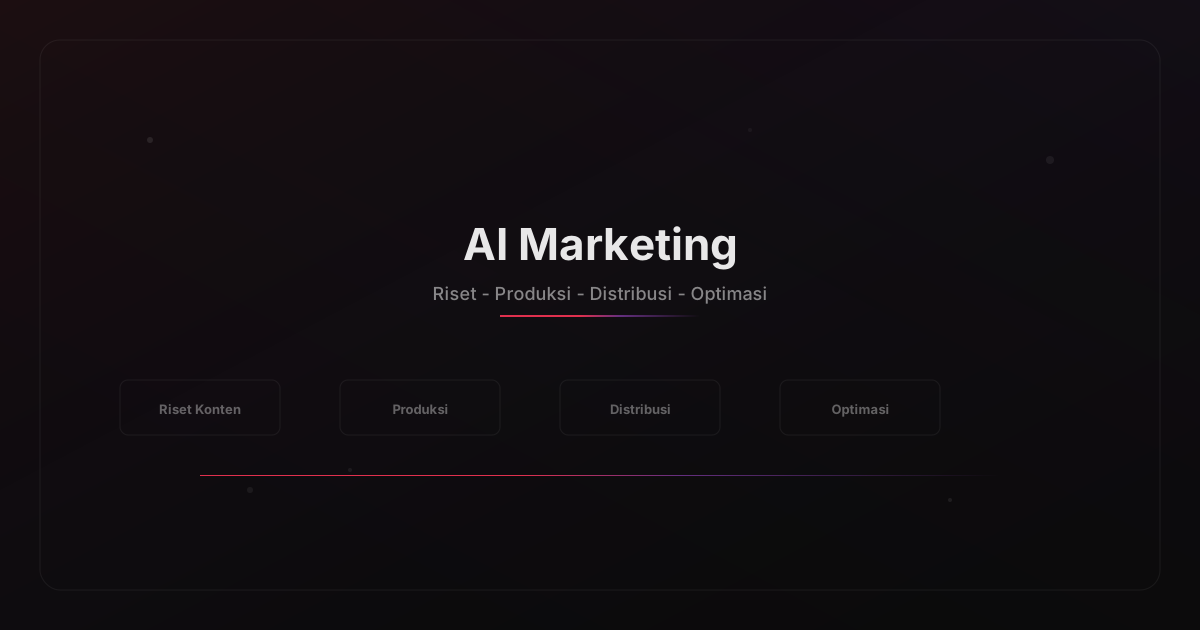
Content marketing is one of the fields that has benefited the most from Artificial Intelligence. From topic research, content production, to distribution — AI can help at almost every stage. In 2026, AI tools for content marketing are becoming increasingly sophisticated and accessible, even for beginners.
Why AI Matters for Content Marketing
Imagine having to write ten blog articles, create twenty social media posts, and design five email campaigns in one week. Without AI, this task would take days. With AI, you can complete it in hours. AI not only speeds up production but also helps improve content quality through data-driven insights.
Additionally, AI can help personalize content for different audiences. With rapid data analysis, AI can determine the most relevant topics, the most effective writing style, and the best time to publish content.
AI for Content Research
Research is the foundation of successful content marketing. AI can help analyze search trends, identify trending topics, and even recommend article titles with viral potential. Tools like AI chat can be used to brainstorm content ideas in seconds.
With AI, you can also quickly analyze competitor content. Simply enter a competitor article URL, and AI will summarize the topic, structure, and keywords they used. This information is invaluable for developing a better content strategy.
AI for Content Production
AI Copywriting
AI copywriting has advanced significantly. AI can now write blog articles, social media captions, marketing emails, and video scripts with quality almost indistinguishable from human writing. All you need to do is provide a clear prompt and do light editing for a personal touch.
AI-Generated Visuals
Besides text, AI can also generate visuals for marketing content. With AI image generator tools like the one at Farisium, you can create illustrations, banners, thumbnails, and other visual elements without graphic design skills. Just describe what you want, and AI will bring it to life.
AI for Distribution and Optimization
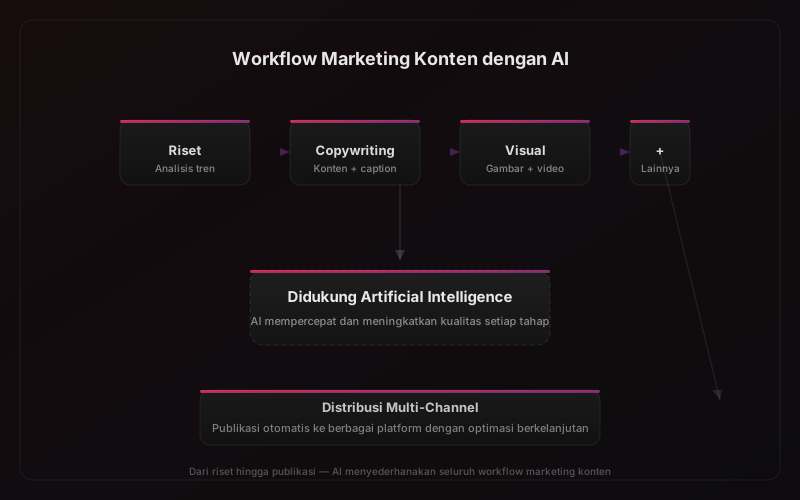
After content is produced, AI can also help distribute it to the right channels. AI can analyze which platforms are most suitable for each content type, optimal posting times, and even auto-generate different captions for each platform.
For optimization, AI can perform automated A/B testing, analyze content performance metrics, and provide improvement recommendations. With an AI-powered production cycle, you can continuously improve your content quality over time.
Best AI Marketing Tools 2026
Here are some AI marketing tools worth trying in 2026: ChatGPT ↗ for copywriting and brainstorming, Canva ↗ AI for visual design, Jasper ↗ for long-form content, and Midjourney ↗ for high-quality images. Choose the tools that best fit your marketing team needs and budget.
A Sample Weekly Workflow for a Small Content Team
So this does not stay theoretical, here is a concrete workflow a small team (1-3 people) can apply with full AI support. Assume your weekly output is two blog articles, five social media posts, and one email newsletter:
- Monday — Research and planning (2 hours): use AI to analyze trending topics, keyword opportunities, and audience questions from communities. Output: a prioritized list of content ideas.
- Tuesday — Article production (3 hours): build outlines with AI, write drafts section by section with original data and firsthand experience, then edit for brand voice.
- Wednesday — Visual production (2 hours): generate supporting illustrations and carousel designs; one session can produce assets for the entire week.
- Thursday — Channel adaptation (2 hours): turn articles into social captions, threads, and short video scripts with AI help, then manually adjust the tone per platform.
- Friday — Metrics review and iteration (1 hour): evaluate last week's content, note winning patterns, and feed findings into next week's planning.
That is roughly ten hours per week — a realistic load even for one person. The key is that AI handles speed and volume while you keep control of strategy, perspective, and quality. Without human review at the end of the process, this workflow only produces generic content that is easy to forget.
Common Mistakes Marketers Make with AI
- Publishing raw output without editing — readers quickly recognize generic AI text with no personality, and it erodes brand credibility.
- Chasing volume alone — publishing thirty mediocre articles is far weaker than eight in-depth pieces that answer your audience's questions.
- Giving no context in prompts — poor AI output is usually not the tool's fault but minimal input about audience, goal, and tone.
- Ignoring performance data — AI needs feedback; without reviewing metrics, you will keep producing identical content even when it does not perform.
- One prompt for every platform — Instagram captions, blog articles, and emails have different rhythms. Always request channel-specific adaptations.
Conclusion
AI has become a game-changer in content marketing. From research, production, to distribution — AI helps marketers work faster, smarter, and more efficiently. Start integrating AI into your content marketing strategy now and experience the difference. Explore our AI for Work Productivity guide, and read about AI for Content Creators for more insights.
For small businesses just starting out with AI marketing, read AI for Small Business 2026, which covers affordable tools and strategies for small and medium businesses.
The simplest way to start: pick one single stage from the weekly workflow above — say Monday content research — and run it for two full weeks until it feels natural. Once one stage is stable, add the next one. Gradual adoption like this is far more likely to stick than trying to overhaul your entire content process overnight.
Try Farisium AI tools for your content marketing
Explore Farisium AI ToolsFrequently Asked Questions
AI is a tool, not a replacement. Content writers are still needed for strategy, creativity, and the personal touch that AI cannot provide.
Costs vary depending on the tools used. Some tools like Farisium offer free access with a coin system — get free FRSC through daily Rewards — while premium tools require monthly subscriptions.
Google does not prohibit AI-generated content as long as it is high-quality and provides value to users. Focus on quality, not on who created it.
Related Articles
What Is Open Source AI? Definition, Platforms, and How to Choose
What is open source AI? A complete guide to how it differs from proprietary AI, popular platforms like TensorFlow and PyTorch, and how to choose wisely.
What Model Does AI Mode on Google Use? Everything You Need to Know
What model does AI mode on Google use? The full answer: Gemini 3 behind AI search, its key features, limitations, and how to access it in 2026.
AI for E-commerce Business: Strategies and Tools 2026
AI e-commerce guide for 2026: boost sales with personalization, chatbots, and supply chain optimization. Complete strategies and tools for online stores.

M. Faris Deni K.
Founder & Developer of Farisium. Writing about AI, technology, and platform development.