
AI Watermarks Are Becoming Mandatory: What Content Creators Need to Know in 2026
AI watermark rules are now mandatory since August 2026 under EU regulation. Learn how SynthID and C2PA work, and what it means for creators.
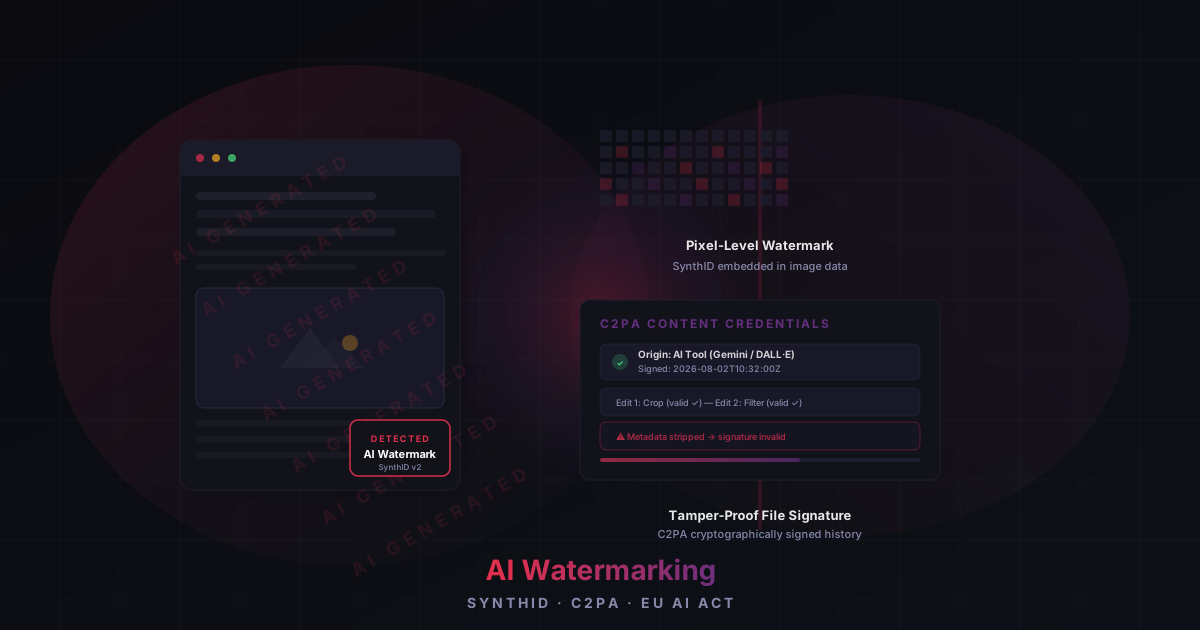
Try this: upload an AI-generated image to Gemini or a recent version of ChatGPT and ask, "was this made by AI?" The system can now answer with real confidence, not just an educated guess based on how the image looks. That's not a coincidence. Since August 2, 2026, the EU AI Act's transparency rules have been in application, requiring AI systems to let users know when they are interacting with AI or encountering AI-generated content, and nearly every major AI company — Google, OpenAI, Anthropic, ElevenLabs — has added watermarking systems to their products within the past few months.
This isn't just a distant European regulatory story. If you're a content creator, freelancer, teacher, or just someone who runs into content on social media regularly, this is directly relevant: how you verify content, how you prove your own work is genuine, and how platforms judge your content are all shifting right now.
What's Actually Happening
The transparency provisions of the EU AI Act (artificialintelligenceact.eu ↗) that became applicable on August 2, 2026 require generative AI providers to mark synthetic output in a machine-readable way as AI-generated rather than human-made. Deployers, meanwhile, must clearly label deepfakes and disclose significant AI-generated written content. In response, Anthropic added machine-readable watermarks to Claude's output for models released in Europe from that date onward, with older models expected to follow. This isn't an isolated move — at Google I/O in May 2026, Google announced that OpenAI, ElevenLabs, Kakao, and NVIDIA are all adopting its SynthID ↗ watermarking system.
The bottom line: AI content now carries a hidden marker designed to be difficult to strip out, and a growing number of companies are required to include it by default, not as an optional feature.
How AI Watermarking Actually Works
There are two main systems worth knowing by name, since you'll keep running into them:
- SynthID (deepmind.google/technologies/synthid) — Google DeepMind's invisible watermark, embedded directly into an image's pixels or an audio file's waveform. Invisible to the naked eye, but still detectable even after cropping, filtering, screenshotting, or recompressing.
- C2PA Content Credentials (c2pa.org ↗) — essentially a tamper-proof digital receipt attached to a file, recording where it came from (a real camera or an AI tool) and its edit history. That record is cryptographically signed, so tampering with it breaks the signature and gives it away.
The difference: SynthID survives light compression and editing but needs a specific tool to read it, while C2PA is easier to read but more likely to disappear if the file's metadata gets stripped — which many platforms, including WhatsApp, do automatically on upload.
What This Means for Content Creators and Freelancers
If your work involves AI in any way — generating images, drafting text, or AI-assisted editing — a few things are worth paying attention to starting now:
- Clients can now more easily check whether your deliverable is purely AI output or has real manual work behind it — being upfront about your process can become an asset rather than something to hide.
- Some social platforms and marketplaces are starting to require an "AI-generated" label on content where a watermark is detected — check the policies of the platforms you use regularly, since these rules are still evolving.
- If you use AI as a tool rather than a full replacement for your creative process, it's better to be transparent about that upfront with clients than to have it surface later through a watermark and lose their trust.
If you're just starting to bring AI into your workflow, the guide to AI for freelance designers covers how to balance AI assistance with the personal touch that remains your real selling point.
How to Check If Content Has an AI Watermark
- Fastest method: upload the image to the Gemini app and directly ask "was this made or edited with AI?" — Gemini can read the SynthID watermark directly.
- For content from the OpenAI ecosystem, try third-party tools or OpenAI Verify — following its 2026 partnership with Google, these tools can also read SynthID.
- Important: a "no watermark detected" result is NOT proof the content is genuinely human-made — it could simply mean no watermark was ever added, or that a platform stripped it out.
What This System Doesn't Solve
It's worth not overtrusting this system. Not every AI tool adds a watermark — plenty of open-source models and smaller tools haven't adopted this standard at all. Messaging platforms like WhatsApp, iMessage, and many social apps automatically recompress uploaded images, which can strip metadata (though SynthID is specifically designed to be more resistant to this than ordinary metadata). And most importantly: a "not detected" result is often misread as "definitely genuine" — when it really just means "no watermark was found," which is a very different claim.
Conclusion
AI watermarking isn't a perfect solution, but it's a real first step toward content transparency at an industry-wide scale, not just individual company promises. If you work in content, the safest way to navigate this shift isn't avoidance — it's being upfront about how you use AI in your process, which tends to build stronger client trust over time. For a broader look at using AI responsibly, read the beginner's guide to generative AI.
Learn how to use AI tools transparently and responsibly
Explore Farisium AI ToolsFrequently Asked Questions
Not yet all of it. Major companies like Google, OpenAI, Anthropic, and ElevenLabs have implemented it, especially for content generated in Europe due to regulatory requirements. But many smaller or open-source AI tools haven't adopted this standard, so the absence of a watermark doesn't automatically mean content isn't AI-made.
The most practical method is uploading the image to the Gemini app and directly asking whether it was made or edited with AI. For content from the OpenAI ecosystem, try OpenAI Verify. Both tools can now read the SynthID watermark following the cross-company partnership announced in 2026.
SynthID is an invisible watermark embedded directly into pixel or audio data, resistant to cropping and compression but requiring a specific tool to read. C2PA Content Credentials is a cryptographically signed file history record, easier to read but more likely to be lost if a platform strips the metadata. The two are often used alongside each other rather than as replacements.
Metadata-based systems like C2PA are relatively easy to lose through screenshots or re-uploads to platforms that recompress files. SynthID is designed to be more resilient since it's embedded in the pixel or audio data itself, but no system today is completely tamper-proof — this is an area still actively being developed as more companies adopt the standard.
Related Articles
Google’s New Feature Lets You Save an Item’s Location Without a Tracker
Google added a feature to Find Hub that lets you save where you put your passport, spare key, or anything else — no Bluetooth tracker needed. Here’s how it works.
Android 17: New Features, Security Upgrades, and AI’s Growing Role in Chrome
Android 17 focuses on security first: anti-theft protection on by default, stricter PIN attempt limits, on-device AI threat detection, and Gemini coming to Chrome on Android.
How to Use AI for Research Without Hallucinations: A 7-Step Verification Workflow for 2026
Learn how to use AI for research without blindly trusting its answers. This practical 7-step workflow helps you verify sources, detect hallucinations, fact-check claims, and produce more reliable research.

M. Faris Deni K.
Agentic AI Leader. Writing about AI, technology, and platform development.