
How to Fact-Check AI Answers: A Practical 7-Step Workflow for Reliable Research in 2026
Learn how to fact-check AI answers with a practical 7-step workflow. Discover how to verify sources, detect hallucinations, compare evidence, and build more reliable AI research habits.
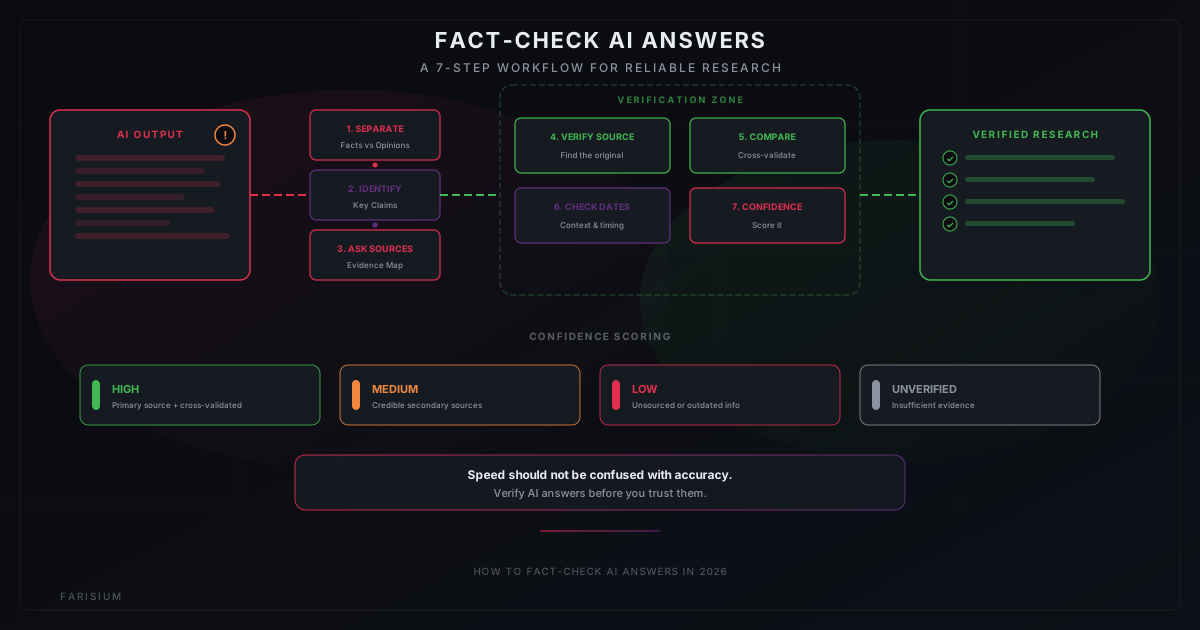
AI can help you research a topic in seconds. Ask a question, and you may receive a detailed answer with explanations, statistics, examples, and even links to sources. The problem is that a confident-looking answer is not automatically a correct answer.
AI systems can misunderstand context, combine unrelated information, rely on outdated information, or present an incorrect statement with convincing language. This is commonly described as an AI hallucination.
That does not mean AI is unreliable or useless. It means the way you use it matters. For research, the safest approach is not to treat AI as the final authority. Instead, use it as a research assistant and verify important claims before relying on them.
This guide presents a practical seven-step workflow for checking AI-generated information without turning every research task into hours of manual investigation.
Why AI Answers Need Verification
The biggest mistake people make with AI research is assuming that detailed answers are accurate answers. An AI model can generate a response that sounds authoritative even when part of the information is incomplete or incorrect.
This happens because language models are designed to generate useful responses based on patterns learned from data. They are not automatically connected to a perfect, real-time database of facts.
There is another problem: information can become outdated. A technology specification, software feature, regulation, pricing model, search guideline, or product capability can change after the information used to produce an answer was created. That means even an answer that was accurate in the past may no longer be accurate today.
Google's current Search guidance also emphasizes that useful content should provide specific value rather than simply repeating information that can easily be generated elsewhere. That principle is especially important when publishing AI-assisted content. (Google Spam Policies ↗)
The goal is therefore not to stop using AI. The goal is to build a verification process around it.
Step 1: Separate Facts From Opinions
Start by identifying what type of information the AI is giving you. Not every sentence needs the same level of verification.
For example:
- "Python is a programming language." — A basic factual statement.
- "Python is the best programming language for beginners." — An opinion or general recommendation.
- "Python 3.14 introduced a specific feature." — A version-specific technical claim that should be verified against official documentation.
- "The company increased its revenue by 35%." — A quantitative claim that should ideally be verified against a primary financial source.
Before researching further, divide the answer into three categories: facts, opinions or recommendations, and claims requiring evidence. This immediately makes the verification process more efficient. You do not need to spend ten minutes proving something that is simply an opinion.
Step 2: Identify the Claims That Matter
Long AI responses can contain dozens of individual claims. Trying to verify every sentence is inefficient. Instead, identify the claims that could materially change the conclusion.
These usually include statistics, prices, dates, legal requirements, medical information, financial information, technical specifications, product capabilities, company announcements, research findings, security recommendations, and statements attributed to organizations or experts.
For example, imagine an AI response says: "Tool X is cheaper, faster, and more accurate than Tool Y." That is not one claim. It contains at least three: Tool X is cheaper, Tool X is faster, and Tool X is more accurate. Each claim may require different evidence.
Breaking complex statements into smaller claims makes hallucinations much easier to detect.
Step 3: Ask AI to Show Its Sources
If you are using an AI system for research, ask it to identify the source behind important claims. A useful prompt is: "List the specific claims in your answer that require verification. For each claim, explain what type of primary source would be appropriate."
You can also ask: "Separate your answer into verified information, uncertain information, and assumptions." This is more useful than simply asking "Are you sure?" An AI system saying "yes" does not constitute evidence.
The objective is to turn the answer into a research map. For example, if AI claims Google changed its documentation regarding AI-generated content, the best source would be Google Search Central documentation. If it says a software feature was introduced in version 5.2, the best source is the software official release notes.
Step 4: Verify the Original Source
Once you have identified a source, do not stop at a search result snippet. Open the original source. This is one of the most important habits in AI-assisted research.
A secondary article might summarize an announcement incorrectly. A social media post might remove important context. A search snippet might display only part of a sentence. The original source gives you the surrounding context.
Prioritize sources according to the type of claim. For technology: official documentation, release notes, developer documentation, official announcements. For companies: official newsroom, investor relations pages, regulatory filings. For scientific claims: original research, academic journals, university publications. For government or regulations: government websites, official regulatory documents.
For example, Google Search documentation is particularly valuable when researching current SEO practices because Google guidance can change over time. Google has continued updating its Search documentation during 2026, including guidance related to AI features, preferred sources, and spam policies. (Google Search Documentation Updates ↗)
Step 5: Compare Independent Sources
One source can be wrong. Two sources can also repeat the same mistake. This is why source independence matters.
Suppose an article claims "Software X is 40% faster than Software Y." You find five websites repeating the same number. That does not necessarily mean the claim is independently verified. They may all be referencing the same original benchmark.
A stronger approach is to find different types of evidence. For example: official documentation confirms the feature exists, an independent benchmark measures performance, and a technical review tests the product in a real-world environment. Now you have multiple perspectives. For academic or scientific claims, tools like Google Scholar ↗ help you trace a finding back to its original peer-reviewed study.
The question is not simply "Do multiple websites say this?" The better question is: "Does independent evidence support this claim?"
Step 6: Check Dates and Context
A fact without a date can become misleading. This is particularly important in technology. A statement such as "Product X supports feature Y" could have been correct two years ago. But perhaps the feature was removed. Or perhaps it is now available only on a specific plan. Or perhaps the product changed completely.
Always check: publication date, last updated date, software version, geographic region, pricing plan, applicable conditions, and original context.
The same principle applies to Google Search. Search guidance evolves. The Google Search documentation updates page shows that Search documentation continues to change, including updates made during August 2026. This means old SEO advice should not automatically be treated as current SEO advice.
A useful research habit is to ask: "When was this information true?" Then ask: "Is it still true today?"
Step 7: Build a Confidence Score
You do not always need a binary answer of "true" or "false." Real-world research often contains uncertainty. A simple confidence system can make your research more practical.
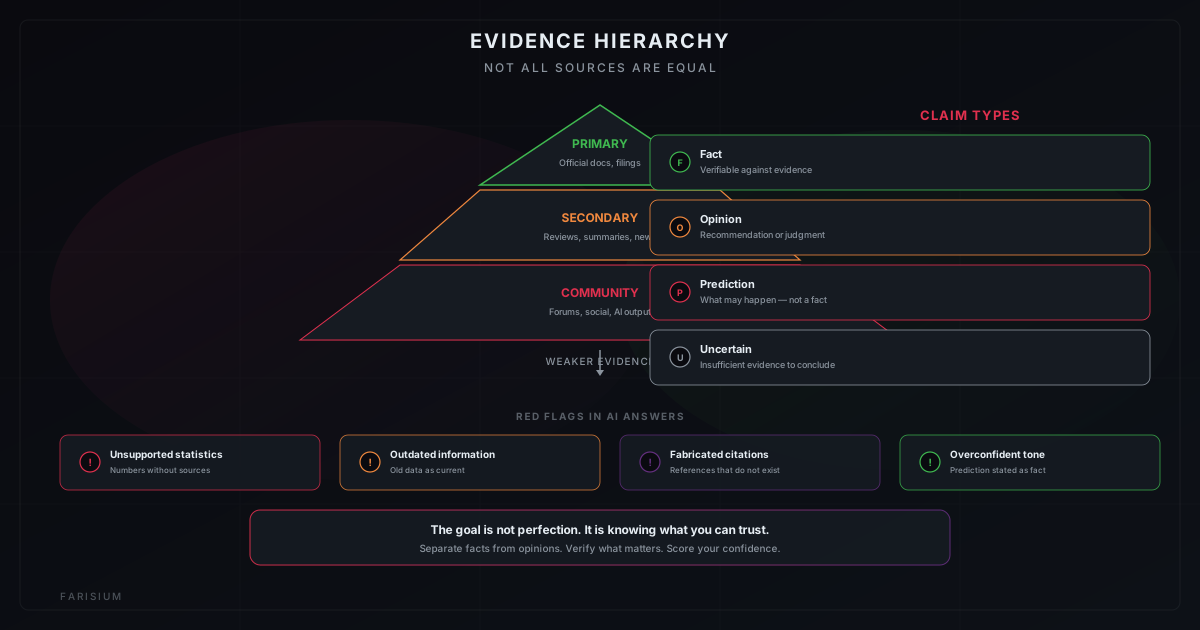
- High confidence: The claim is supported by a current primary source and independently corroborated where appropriate.
- Medium confidence: The claim is supported by credible secondary sources, but the primary evidence is limited or difficult to verify.
- Low confidence: The claim comes mainly from unsourced articles, social media posts, vague AI responses, or outdated information.
- Unverified: There is not enough evidence to make a reliable conclusion.
This approach is particularly useful when researching emerging technologies. For example, a claim like "AI tool X will replace most software developers by 2027" would score low confidence because it is a prediction rather than an established fact. A better version would be: "AI coding tools are increasingly capable of automating portions of software development, but the extent to which they will replace developers remains uncertain."
That sentence separates observable trends from speculation. For a deeper look at building verification into your AI research process, see how to use AI for research without hallucinations.
A Practical AI Fact-Checking Checklist
Before publishing or acting on AI-generated research, run through this checklist:
- What are the most important claims?
- Which claims contain numbers?
- Which claims contain dates?
- Which claims could have changed recently?
- Is the source primary or secondary?
- Can I find the original document?
- Does the source actually support the claim?
- Is the source current?
- Are multiple independent sources consistent?
- Is the statement a fact, opinion, prediction, or assumption?
- Is there missing context?
- Would a reasonable reader make a different decision if the claim were wrong?
That last question is especially useful. If a wrong claim would have serious consequences, increase the level of verification.
When You Should Never Trust an AI Answer Without Verification
Some topics deserve substantially more caution. Medical decisions are one example. Financial decisions are another. Legal requirements, security vulnerabilities, safety instructions, government regulations, and technical production configurations can also have serious consequences if incorrect information is followed blindly.
In these situations, AI can still help you understand a subject, generate questions, organize information, or explain technical terminology. But the final decision should be based on authoritative evidence and, when appropriate, qualified professionals.
The same principle applies to SEO. AI can suggest keywords, content structures, search intent, internal linking ideas, and article outlines. But it should not be treated as an official source of Google ranking algorithms.
Google's current spam guidance emphasizes that Search policies apply to content created or presented in ways intended to manipulate search systems. It also emphasizes quality, authorship, presentation, and whether content provides meaningful value rather than simply duplicating material found elsewhere.
This is an important distinction for publishers using AI. Using AI is not the same thing as producing valuable content. The value comes from the research, judgment, experience, editing, examples, and useful perspective added by the publisher. If you publish AI-assisted work, you should also understand what AI watermarks mean for content creators.
How to Use AI Without Losing Editorial Quality
A strong workflow looks like this: Research with AI. Identify claims. Find primary sources. Verify important facts. Add your own analysis. Explain the information in a useful structure. Review the final article manually. Then publish.
This is very different from asking AI to generate an article and publishing the output without checking it. The second approach can easily produce generic content. The first approach turns AI into a productivity tool while keeping human judgment in the process.
Google's current guidance around AI and Search similarly emphasizes that content should be specific, useful, reliable, and created for people, rather than simply being generic material that could be produced by anyone. (Google AI Optimization Guide ↗)
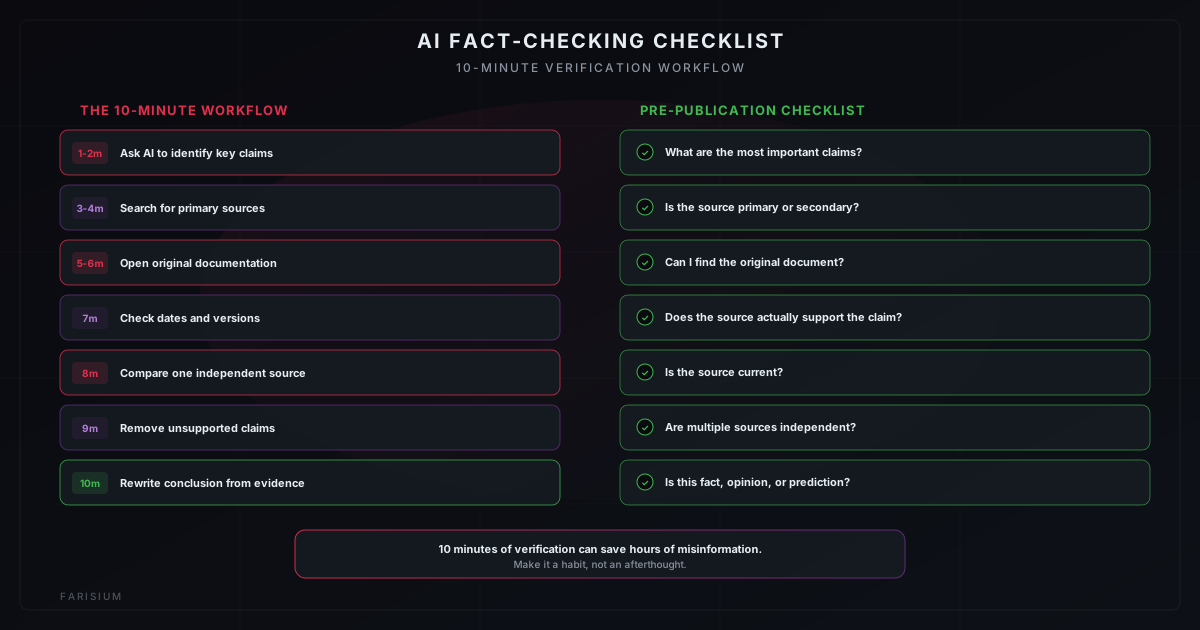
A Simple 10-Minute Verification Workflow
You do not always need a complicated research system. For many everyday technology articles, this workflow is enough:
- Minute 1-2: Ask AI to identify the key claims.
- Minute 3-4: Search for the primary sources.
- Minute 5-6: Open the original documentation or announcement.
- Minute 7: Check dates and versions.
- Minute 8: Compare one independent source.
- Minute 9: Remove unsupported claims.
- Minute 10: Rewrite the conclusion based only on evidence you can support.
The result is usually much stronger than simply asking an AI model to "write a fact-checked article." The difference is that you are actually controlling the verification process. For a broader framework on integrating AI into your work processes, see how to build an AI workflow that saves time.
Final Thoughts
AI is extremely useful for research, but speed should not be confused with accuracy. The best AI-assisted researchers do not blindly trust AI answers. They use AI to accelerate discovery, organize information, identify questions, summarize complex subjects, and explore possible explanations. Then they verify the claims that matter.
A reliable workflow is simple: Ask. Break the answer into claims. Find the evidence. Verify the original source. Compare independent information. Check dates and context. Assign a confidence level. Then make your conclusion.
This approach does more than reduce hallucinations. It also produces better articles, better decisions, and better research habits. The future of AI-assisted research is not about choosing between humans and AI. It is about combining AI speed with human judgment. And when the information actually matters, verification remains the step that turns a convincing answer into a trustworthy one.
Put your fact-checking workflow into practice with AI tools
Explore Farisium AI ToolsRelated Articles
How to Build an AI Workflow That Actually Saves Time in 2026
Learn how to build an AI workflow that saves time instead of adding more tools. This practical framework helps freelancers and small teams choose tasks, design handoffs, add human review, and measure real productivity gains.
How to Build a Private AI Knowledge Base for Small Business: A Practical 2026 Guide
Learn how to build a private AI knowledge base for your small business. This practical guide covers document preparation, retrieval, privacy, testing, access control, and maintenance.
Machine Learning Guide for Beginners 2026
Learn machine learning from scratch. Complete guide covering concepts, types, tools, and practical steps to start your ML journey for beginners.

M. Faris Deni K.
Agentic AI Leader. Writing about AI, technology, and platform development.